
Tinnitus resources
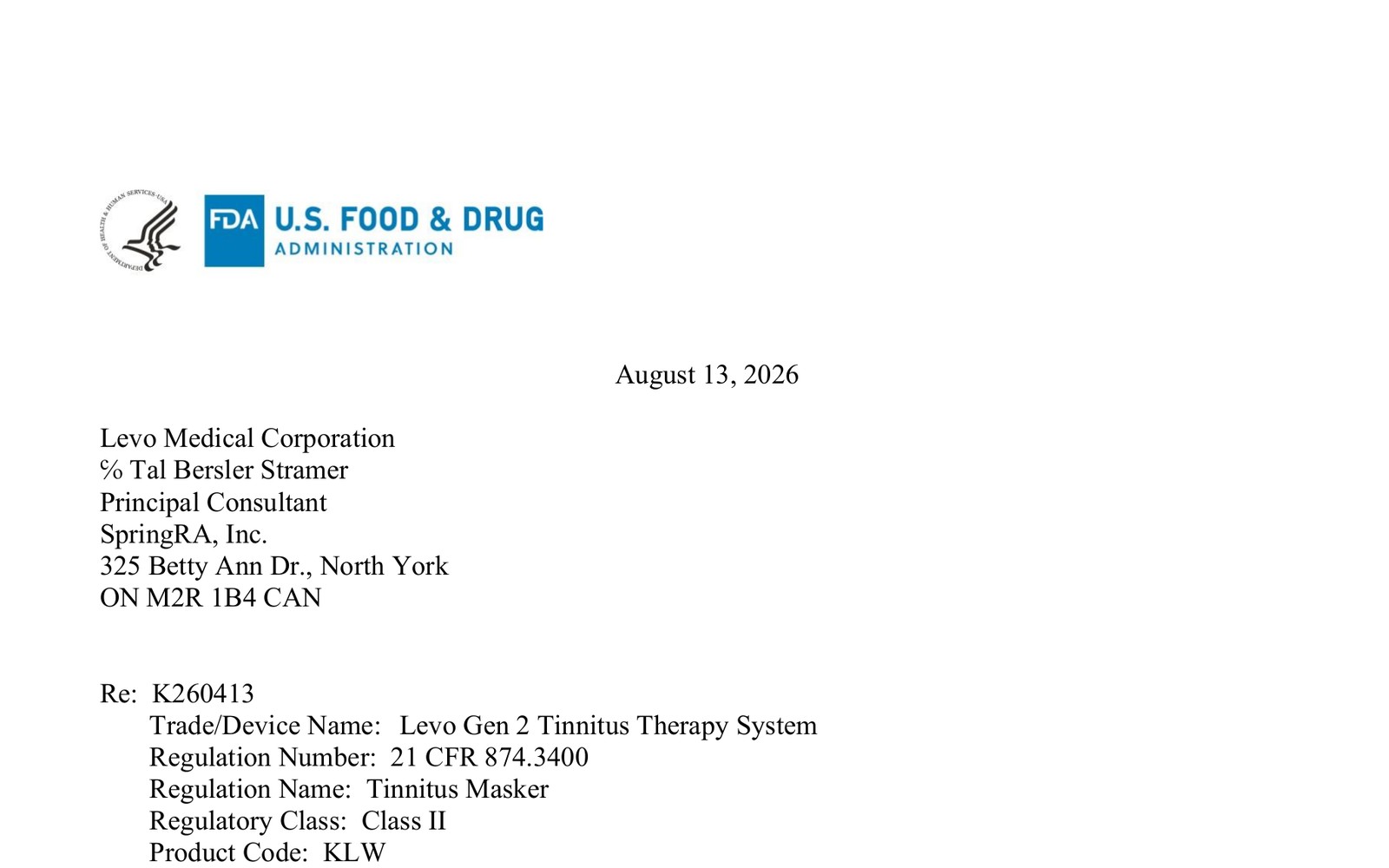
FDA 510(k) clearance of the Levo Gen 2 Tinnitus Therapy System (K260413)
Levo Gen 2 is FDA-cleared for the temporary relief of tinnitus symptoms in adults. 510(k) letter dated August 13, 2026; prescription use only. Device name in the letter: Levo Gen 2 Tinnitus Therapy System. Holder: Levo Medical Corporation. Class II, product code KLW, 21 CFR 874.3400. The app runs on compatible iPhone and iPad devices and combines individualized sound therapy, configured by a hearing professional, with the Continuous Learning Platform (CLP).
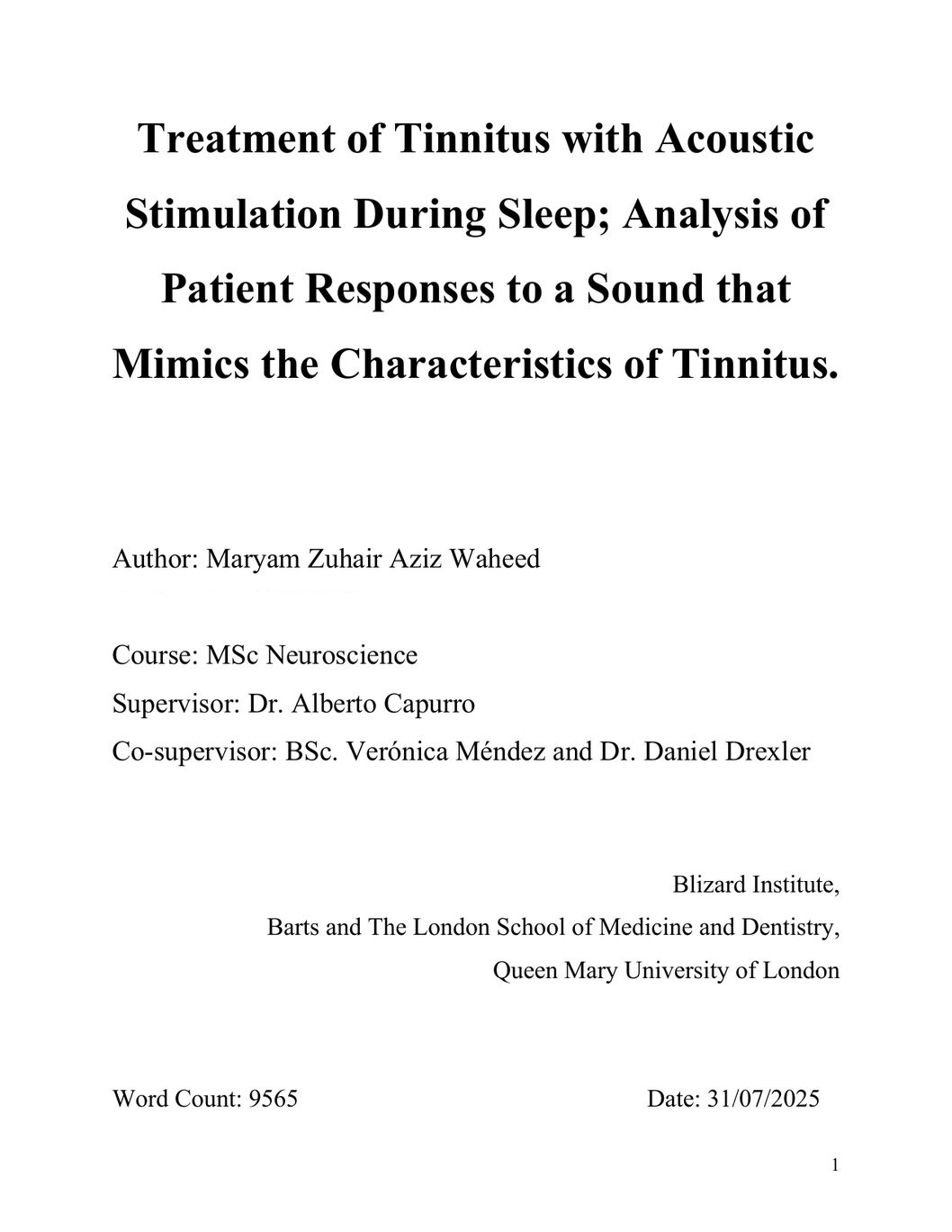
Patient response to a tinnitus-matched sound during sleep
Master’s thesis (Queen Mary University of London), not peer-reviewed. It analyzed how patients respond to the personalized sound that reproduces their tinnitus and how that response changes during treatment. Author: Maryam Zuhair Aziz Waheed. MSc Neuroscience, 2025. Supervisor: Dr. Alberto Capurro; co-supervisors: Verónica Méndez and Dr. Daniel Drexler.
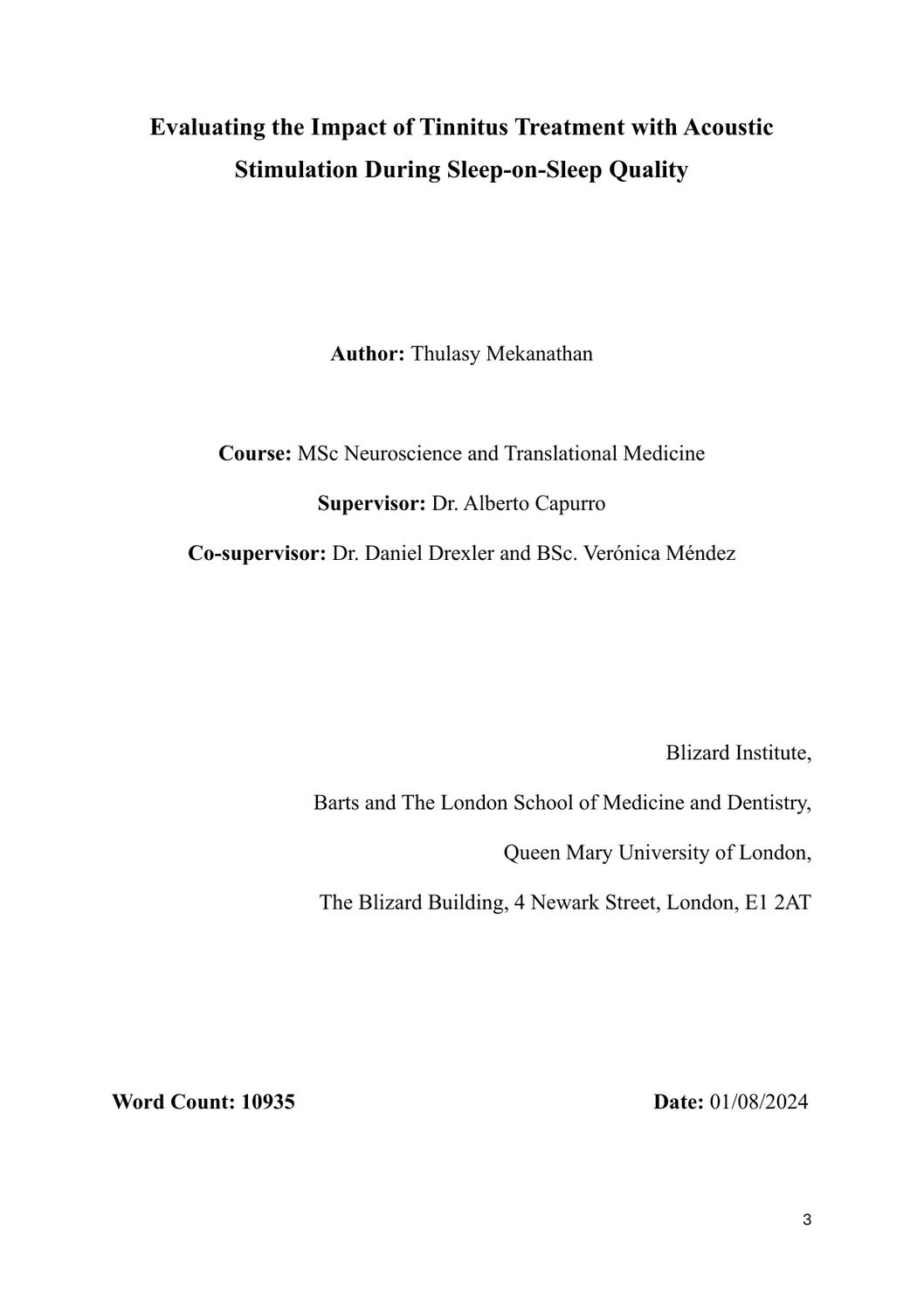
Impact of acoustic stimulation during sleep on sleep quality
Master’s thesis (Queen Mary University of London), not peer-reviewed. It studied how sleep quality evolved during treatment and how it related to changes in tinnitus, using data from patients of Centro Tinnitus Montevideo. Author: Thulasy Mekanathan. MSc Neuroscience and Translational Medicine, 2024. Supervisor: Dr. Alberto Capurro; co-supervisors: Dr. Daniel Drexler and Verónica Méndez.
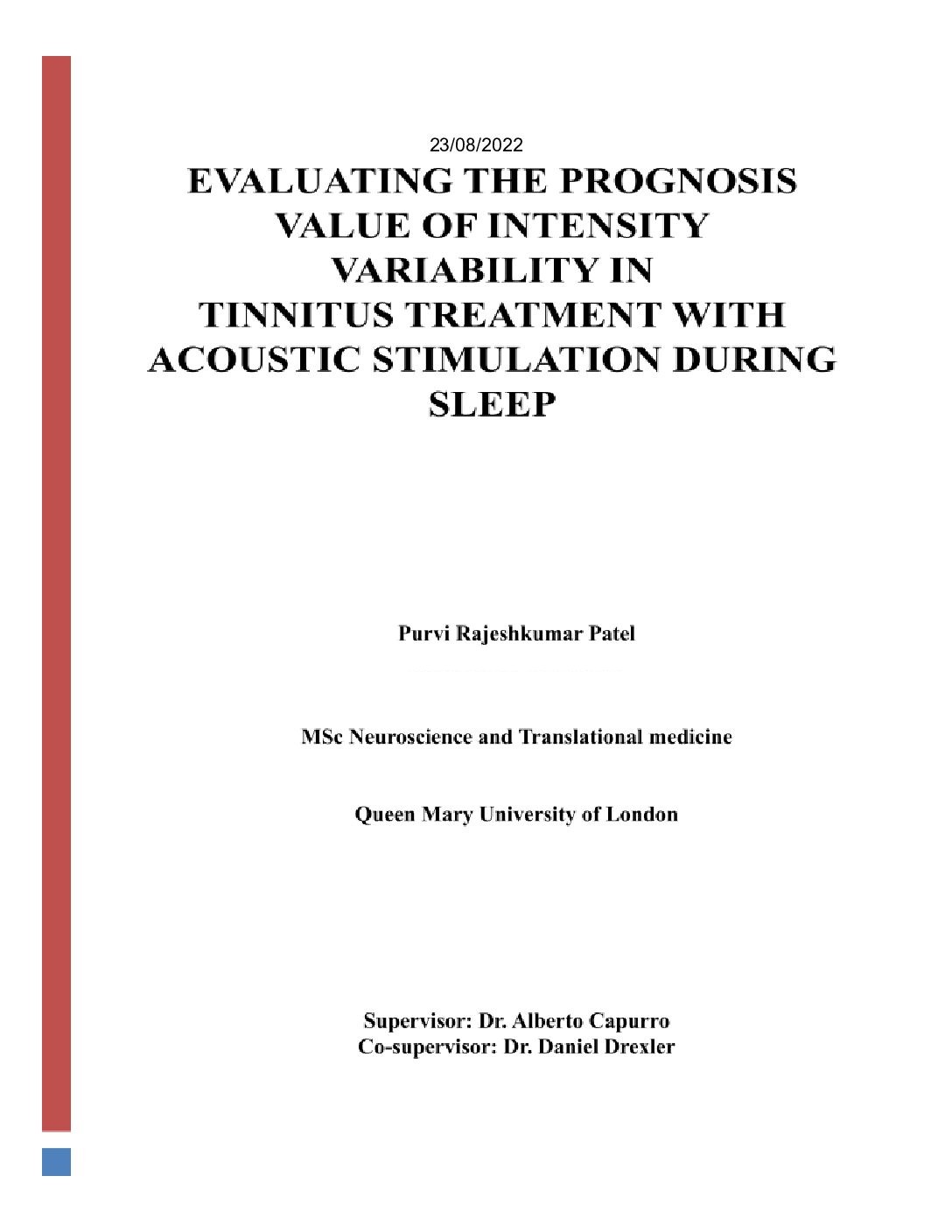
Prognosis and variability in tinnitus treatment with acoustic stimulation during sleep
Master’s thesis (Queen Mary University of London), not peer-reviewed. It analyzed whether early variations in tinnitus intensity relate to how treatment evolves later, using data from patients of Centro Tinnitus Montevideo. Author: Purvi Rajeshkumar Patel. MSc Neuroscience and Translational Medicine, 2022. Supervisor: Dr. Alberto Capurro; co-supervisor: Dr. Daniel Drexler.
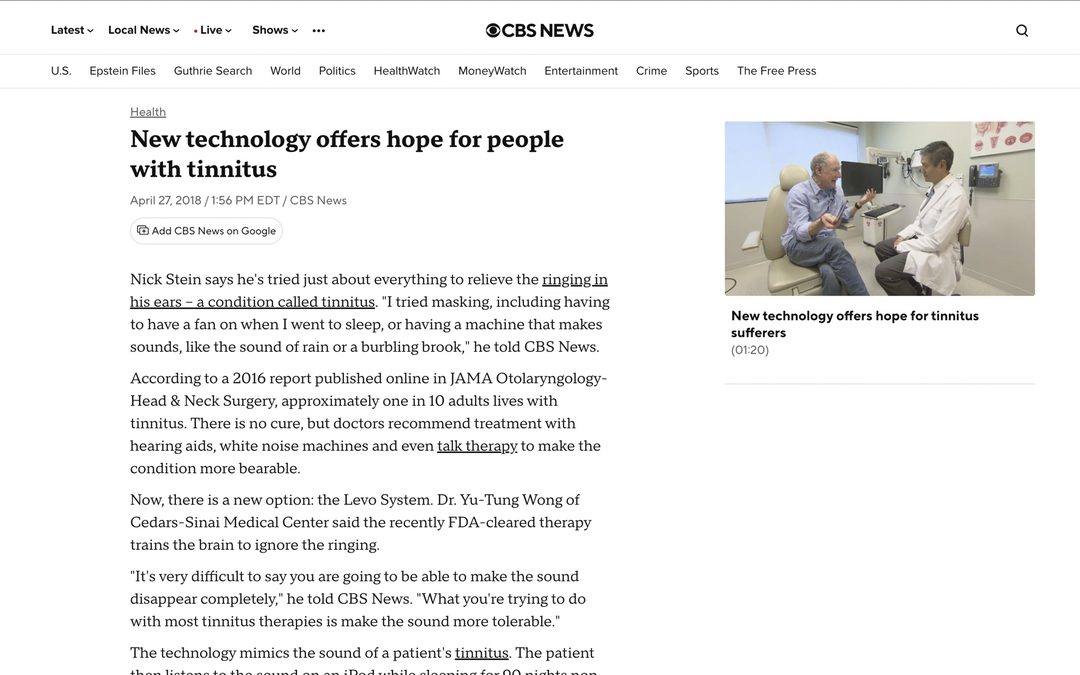
The Levo System at a Los Angeles medical center
CBS New York article from May 1, 2018, on the Levo System, with one patient’s account.
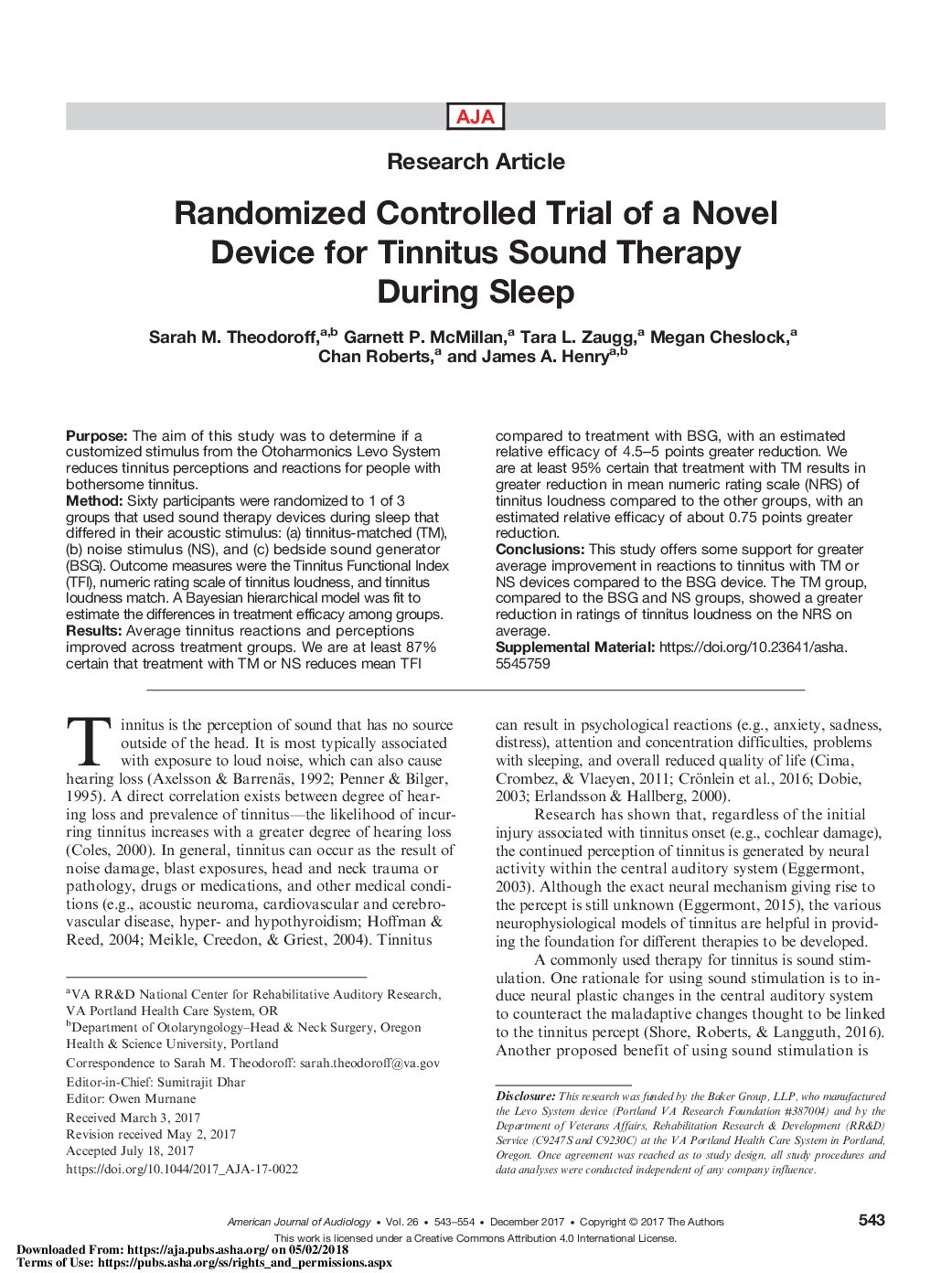
Randomized clinical trial: personalized sound therapy during sleep vs. alternatives
Randomized clinical trial with 60 participants, conducted in the United States. Researchers at the VA Portland Health Care System compared the Levo System with a tinnitus-matched sound, the Levo System with a noise chosen by the participant, and a bedside sound generator; on average, all three groups improved. Funding came from the manufacturer of the device at the time and from the U.S. Department of Veterans Affairs; study procedures and data analyses were conducted independent of company influence. American Journal of Audiology, 2017.
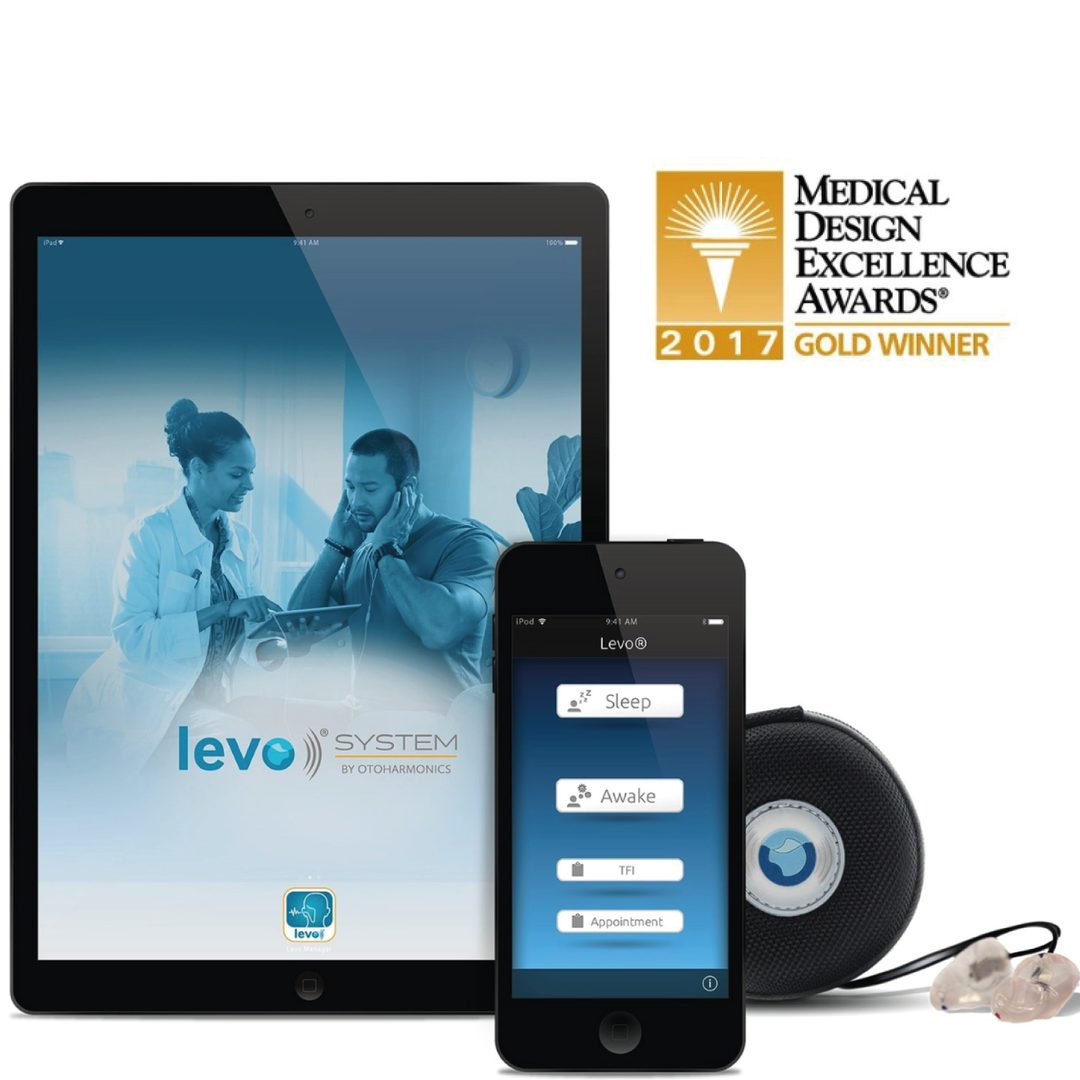
The Levo System Wins Top Honors at the 2017 Medical Design Excellence Awards
PORTLAND, Ore., Otoharmonics today announced that the Levo System has been awarded the top prize in the Digital Health Products and Mobile Medical Apps category of the 19th Annual Medical Design Excellence Awards competition. The 2017 winners were announced at the 2017 MDEA Ceremony on Tuesday, June 13 at the Jacob K. Javits Convention Center in New York.
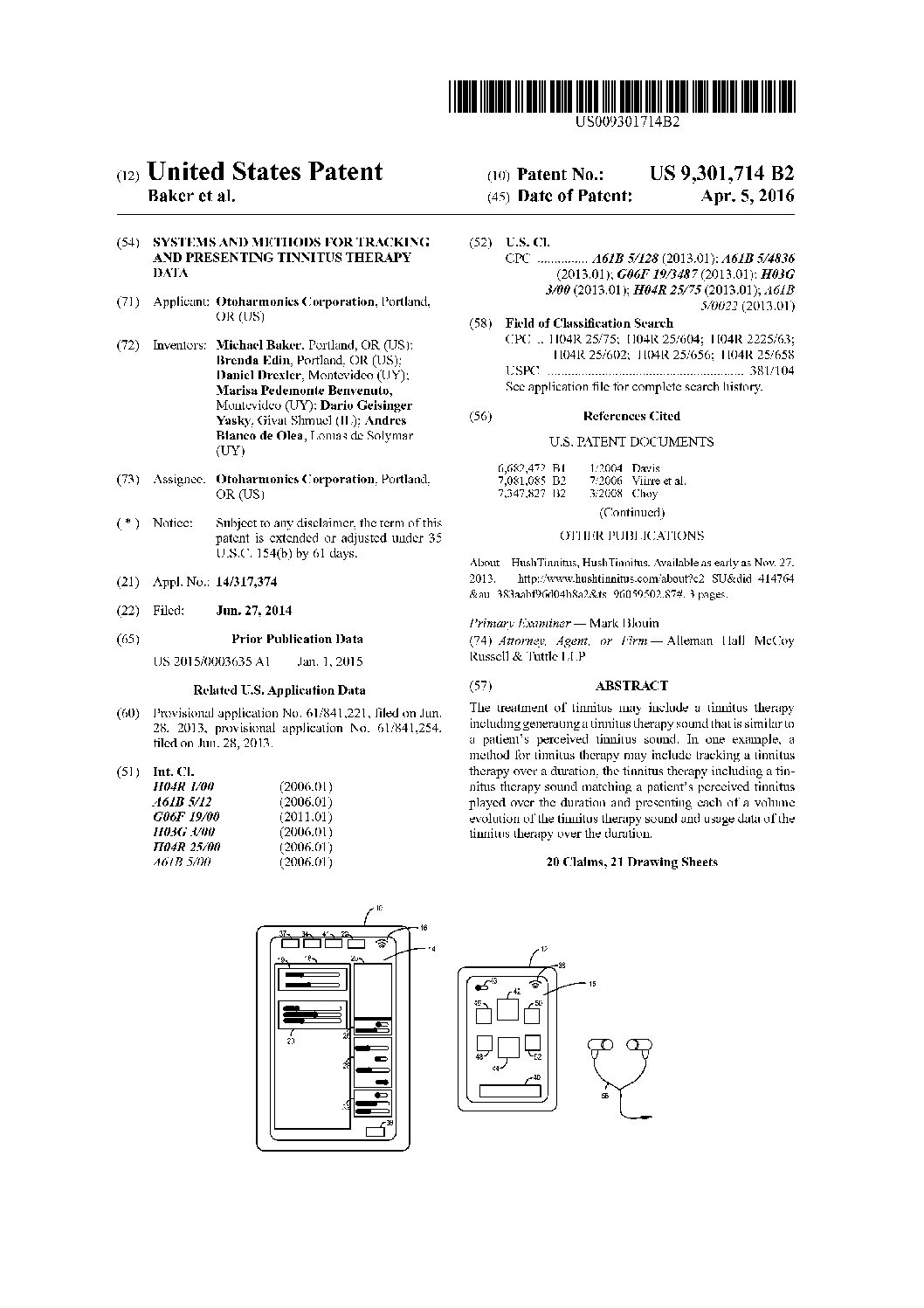
U.S. Patent 9,301,714 B2: systems and methods for tracking and presenting tinnitus therapy data
U.S. patent issued on April 5, 2016. Title: Systems and methods for tracking and presenting tinnitus therapy data. Current assignee: Levo Medical Corporation.

U.S. Patent 9,282,917 B2: systems and methods for tinnitus therapy
U.S. patent issued on March 15, 2016. Title: Systems and methods for a tinnitus therapy. Current assignee: Levo Medical Corporation.
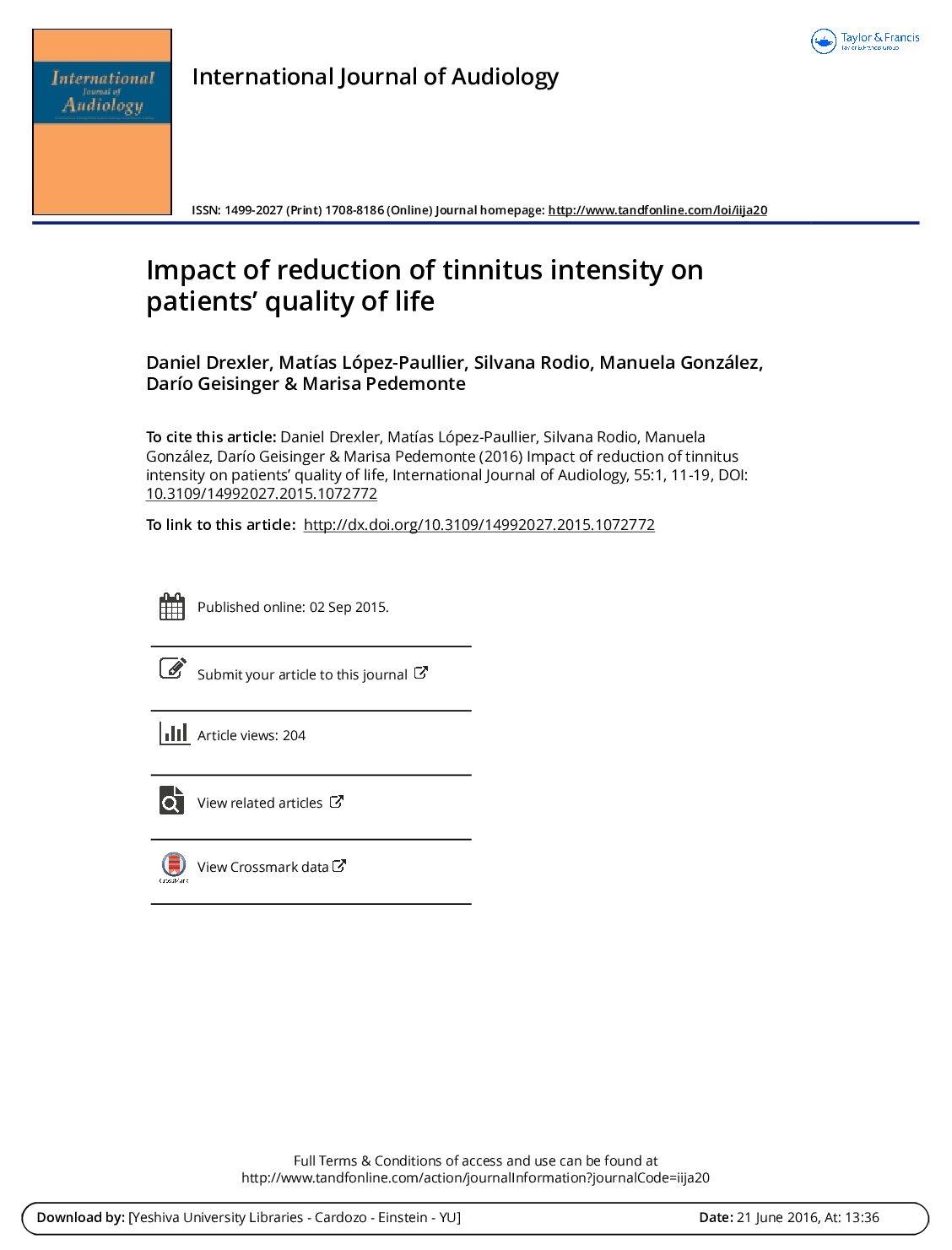
Impact of reduction of tinnitus intensity on patients’ quality of life (2016)
Clinical study with an earlier version of the Levo system (before Levo Gen 2): 12 patients enrolled, 11 completed, 3 months. On average, tinnitus intensity decreased by 80% and its impact on quality of life (TFI) by 77%. Drexler et al., International Journal of Audiology, 2016.
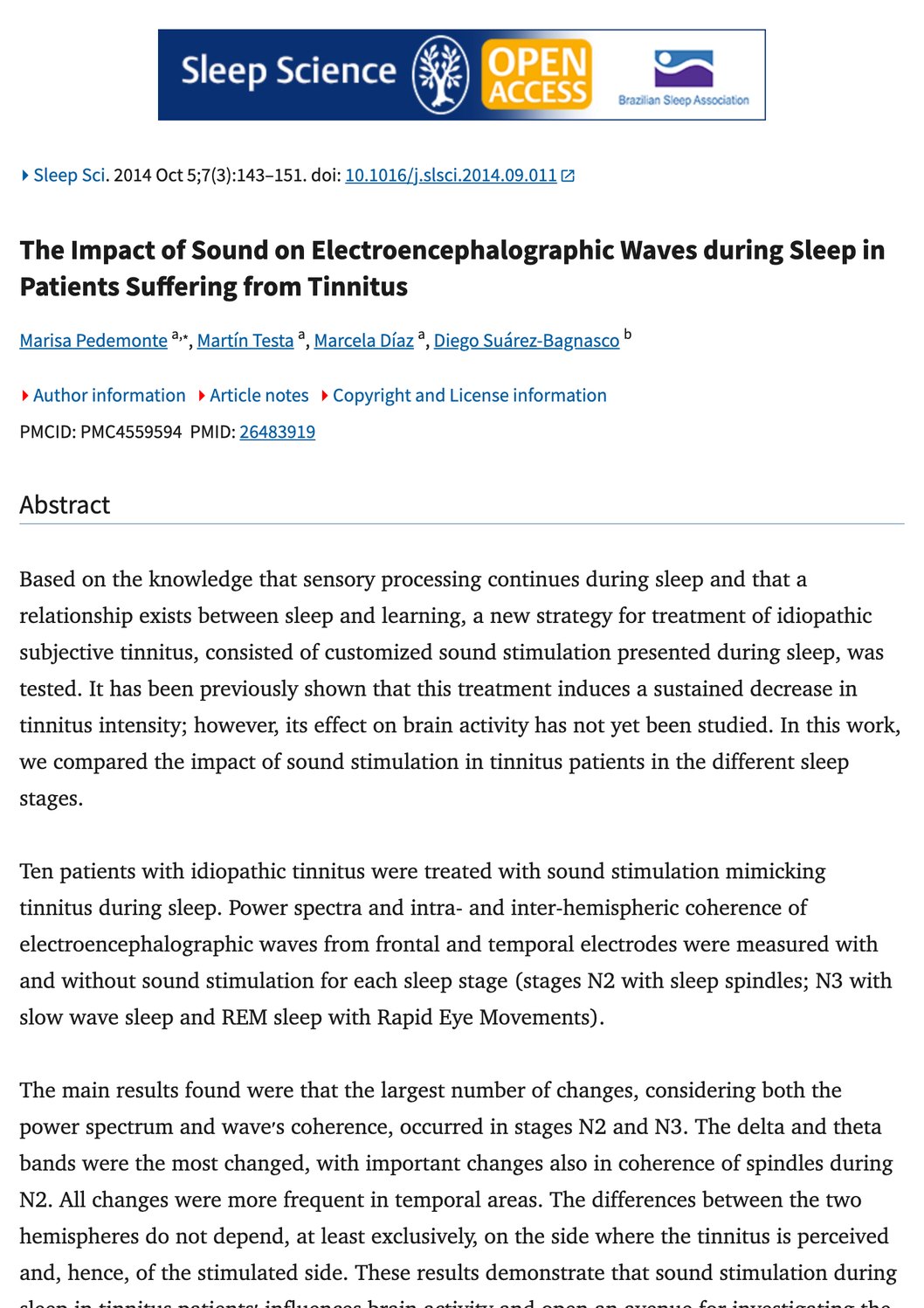
Sound alters brain activity during sleep in patients with tinnitus
EEG study during sleep in 10 patients with tinnitus. It measured brain electrical activity while they received their personalized sound; changes were observed mainly in sleep stages N2 and N3. Sleep Science, 2014.
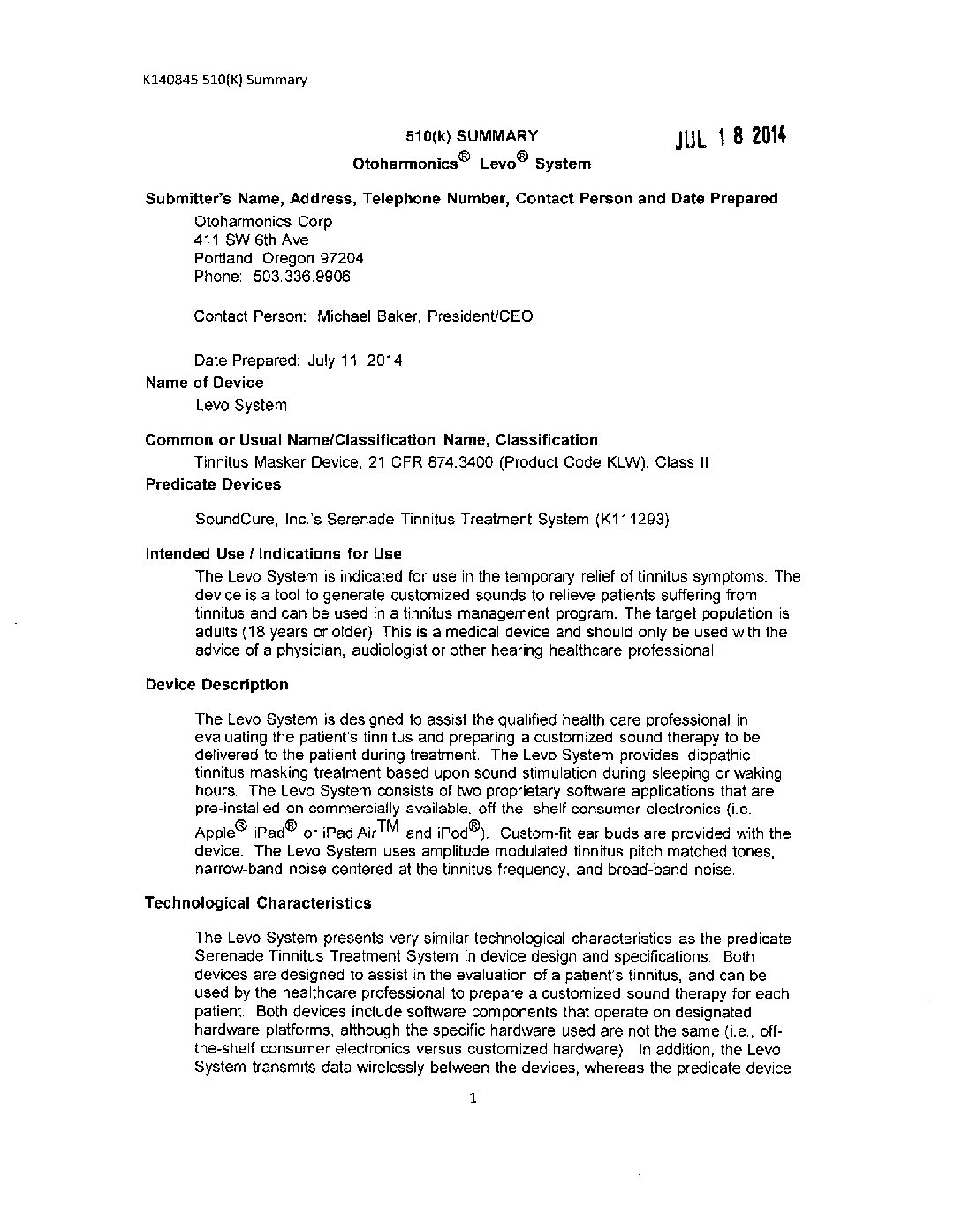
FDA 510(k) clearance of the first-generation Levo System (K140845)
The original Levo System was FDA-cleared for the temporary relief of tinnitus symptoms in adults. 510(k) letter dated July 18, 2014; prescription use only. Device name in the letter: LEVO Tinnitus Masking Software Device. Holder: Otoharmonics. Class II, product code KLW, 21 CFR 874.3400.
Pilot study of personalized acoustic stimulation during sleep (2010)
Pilot study with 11 patients, stimulated every night for 6 months. It presented personalized acoustic stimulation during sleep, the basis for the later development of Levo. International Tinnitus Journal, 2010.
FDA 510(k) clearance of the Levo Gen 2 Tinnitus Therapy System (K260413)
Levo Gen 2 is FDA-cleared for the temporary relief of tinnitus symptoms in adults. 510(k) letter dated August 13, 2026; prescription use only. Device name in the letter: Levo Gen 2 Tinnitus Therapy System. Holder: Levo Medical Corporation. Class II, product code KLW, 21 CFR 874.3400. The app runs on compatible iPhone and iPad devices and combines individualized sound therapy, configured by a hearing professional, with the Continuous Learning Platform (CLP).
U.S. Patent 9,301,714 B2: systems and methods for tracking and presenting tinnitus therapy data
U.S. patent issued on April 5, 2016. Title: Systems and methods for tracking and presenting tinnitus therapy data. Current assignee: Levo Medical Corporation.
U.S. Patent 9,282,917 B2: systems and methods for tinnitus therapy
U.S. patent issued on March 15, 2016. Title: Systems and methods for a tinnitus therapy. Current assignee: Levo Medical Corporation.
FDA 510(k) clearance of the first-generation Levo System (K140845)
The original Levo System was FDA-cleared for the temporary relief of tinnitus symptoms in adults. 510(k) letter dated July 18, 2014; prescription use only. Device name in the letter: LEVO Tinnitus Masking Software Device. Holder: Otoharmonics. Class II, product code KLW, 21 CFR 874.3400.
Patient response to a tinnitus-matched sound during sleep
Master’s thesis (Queen Mary University of London), not peer-reviewed. It analyzed how patients respond to the personalized sound that reproduces their tinnitus and how that response changes during treatment. Author: Maryam Zuhair Aziz Waheed. MSc Neuroscience, 2025. Supervisor: Dr. Alberto Capurro; co-supervisors: Verónica Méndez and Dr. Daniel Drexler.
Impact of acoustic stimulation during sleep on sleep quality
Master’s thesis (Queen Mary University of London), not peer-reviewed. It studied how sleep quality evolved during treatment and how it related to changes in tinnitus, using data from patients of Centro Tinnitus Montevideo. Author: Thulasy Mekanathan. MSc Neuroscience and Translational Medicine, 2024. Supervisor: Dr. Alberto Capurro; co-supervisors: Dr. Daniel Drexler and Verónica Méndez.
Prognosis and variability in tinnitus treatment with acoustic stimulation during sleep
Master’s thesis (Queen Mary University of London), not peer-reviewed. It analyzed whether early variations in tinnitus intensity relate to how treatment evolves later, using data from patients of Centro Tinnitus Montevideo. Author: Purvi Rajeshkumar Patel. MSc Neuroscience and Translational Medicine, 2022. Supervisor: Dr. Alberto Capurro; co-supervisor: Dr. Daniel Drexler.
Randomized clinical trial: personalized sound therapy during sleep vs. alternatives
Randomized clinical trial with 60 participants, conducted in the United States. Researchers at the VA Portland Health Care System compared the Levo System with a tinnitus-matched sound, the Levo System with a noise chosen by the participant, and a bedside sound generator; on average, all three groups improved. Funding came from the manufacturer of the device at the time and from the U.S. Department of Veterans Affairs; study procedures and data analyses were conducted independent of company influence. American Journal of Audiology, 2017.
Impact of reduction of tinnitus intensity on patients’ quality of life (2016)
Clinical study with an earlier version of the Levo system (before Levo Gen 2): 12 patients enrolled, 11 completed, 3 months. On average, tinnitus intensity decreased by 80% and its impact on quality of life (TFI) by 77%. Drexler et al., International Journal of Audiology, 2016.
Sound alters brain activity during sleep in patients with tinnitus
EEG study during sleep in 10 patients with tinnitus. It measured brain electrical activity while they received their personalized sound; changes were observed mainly in sleep stages N2 and N3. Sleep Science, 2014.
Pilot study of personalized acoustic stimulation during sleep (2010)
Pilot study with 11 patients, stimulated every night for 6 months. It presented personalized acoustic stimulation during sleep, the basis for the later development of Levo. International Tinnitus Journal, 2010.
The Levo System at a Los Angeles medical center
CBS New York article from May 1, 2018, on the Levo System, with one patient’s account.
The Levo System Wins Top Honors at the 2017 Medical Design Excellence Awards
PORTLAND, Ore., Otoharmonics today announced that the Levo System has been awarded the top prize in the Digital Health Products and Mobile Medical Apps category of the 19th Annual Medical Design Excellence Awards competition. The 2017 winners were announced at the 2017 MDEA Ceremony on Tuesday, June 13 at the Jacob K. Javits Convention Center in New York.
FDA 510(k) clearance of the Levo Gen 2 Tinnitus Therapy System (K260413)
Levo Gen 2 is FDA-cleared for the temporary relief of tinnitus symptoms in adults. 510(k) letter dated August 13, 2026; prescription use only. Device name in the letter: Levo Gen 2 Tinnitus Therapy System. Holder: Levo Medical Corporation. Class II, product code KLW, 21 CFR 874.3400. The app runs on compatible iPhone and iPad devices and combines individualized sound therapy, configured by a hearing professional, with the Continuous Learning Platform (CLP).
Patient response to a tinnitus-matched sound during sleep
Master’s thesis (Queen Mary University of London), not peer-reviewed. It analyzed how patients respond to the personalized sound that reproduces their tinnitus and how that response changes during treatment. Author: Maryam Zuhair Aziz Waheed. MSc Neuroscience, 2025. Supervisor: Dr. Alberto Capurro; co-supervisors: Verónica Méndez and Dr. Daniel Drexler.
Impact of acoustic stimulation during sleep on sleep quality
Master’s thesis (Queen Mary University of London), not peer-reviewed. It studied how sleep quality evolved during treatment and how it related to changes in tinnitus, using data from patients of Centro Tinnitus Montevideo. Author: Thulasy Mekanathan. MSc Neuroscience and Translational Medicine, 2024. Supervisor: Dr. Alberto Capurro; co-supervisors: Dr. Daniel Drexler and Verónica Méndez.
Prognosis and variability in tinnitus treatment with acoustic stimulation during sleep
Master’s thesis (Queen Mary University of London), not peer-reviewed. It analyzed whether early variations in tinnitus intensity relate to how treatment evolves later, using data from patients of Centro Tinnitus Montevideo. Author: Purvi Rajeshkumar Patel. MSc Neuroscience and Translational Medicine, 2022. Supervisor: Dr. Alberto Capurro; co-supervisor: Dr. Daniel Drexler.
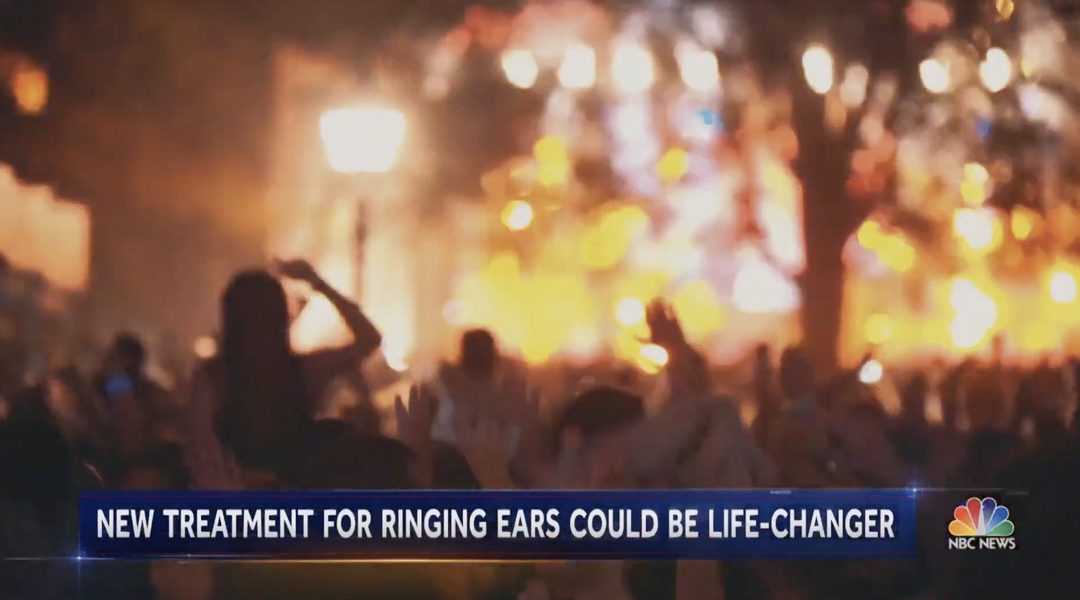
NBC Nightly News report on the Levo System
NBC Nightly News report from July 4, 2018, on the Levo System for tinnitus.
The Levo System at a Los Angeles medical center
CBS New York article from May 1, 2018, on the Levo System, with one patient’s account.
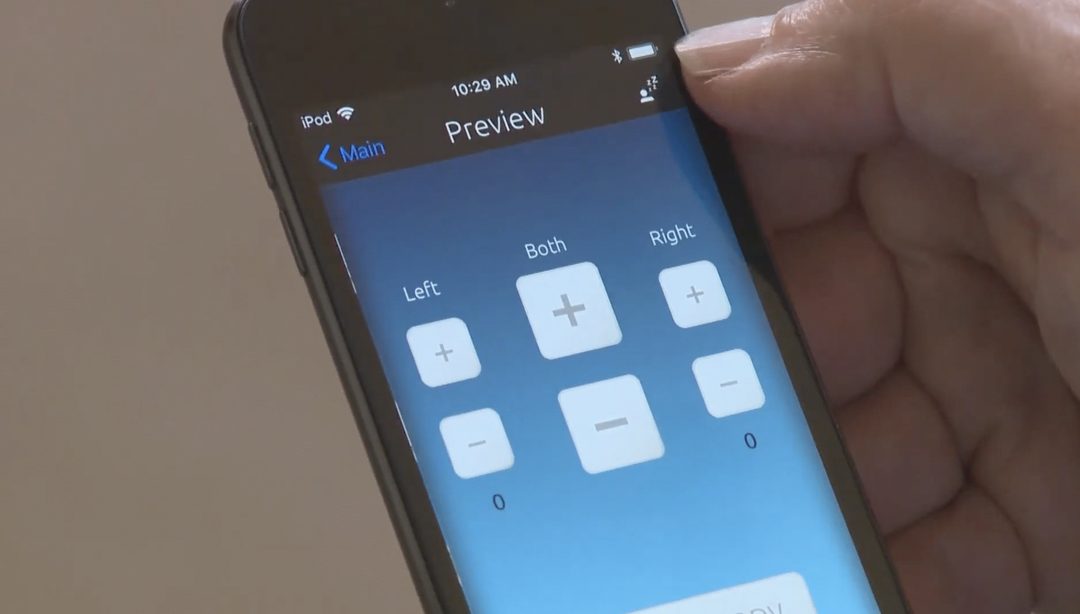
U.S. hospital applies personalized sound therapy for tinnitus treatment
CBS News report from April 27, 2018, from Los Angeles, on personalized sound therapy during sleep.
Randomized clinical trial: personalized sound therapy during sleep vs. alternatives
Randomized clinical trial with 60 participants, conducted in the United States. Researchers at the VA Portland Health Care System compared the Levo System with a tinnitus-matched sound, the Levo System with a noise chosen by the participant, and a bedside sound generator; on average, all three groups improved. Funding came from the manufacturer of the device at the time and from the U.S. Department of Veterans Affairs; study procedures and data analyses were conducted independent of company influence. American Journal of Audiology, 2017.
The Levo System Wins Top Honors at the 2017 Medical Design Excellence Awards
PORTLAND, Ore., Otoharmonics today announced that the Levo System has been awarded the top prize in the Digital Health Products and Mobile Medical Apps category of the 19th Annual Medical Design Excellence Awards competition. The 2017 winners were announced at the 2017 MDEA Ceremony on Tuesday, June 13 at the Jacob K. Javits Convention Center in New York.
U.S. Patent 9,301,714 B2: systems and methods for tracking and presenting tinnitus therapy data
U.S. patent issued on April 5, 2016. Title: Systems and methods for tracking and presenting tinnitus therapy data. Current assignee: Levo Medical Corporation.
U.S. Patent 9,282,917 B2: systems and methods for tinnitus therapy
U.S. patent issued on March 15, 2016. Title: Systems and methods for a tinnitus therapy. Current assignee: Levo Medical Corporation.
Impact of reduction of tinnitus intensity on patients’ quality of life (2016)
Clinical study with an earlier version of the Levo system (before Levo Gen 2): 12 patients enrolled, 11 completed, 3 months. On average, tinnitus intensity decreased by 80% and its impact on quality of life (TFI) by 77%. Drexler et al., International Journal of Audiology, 2016.
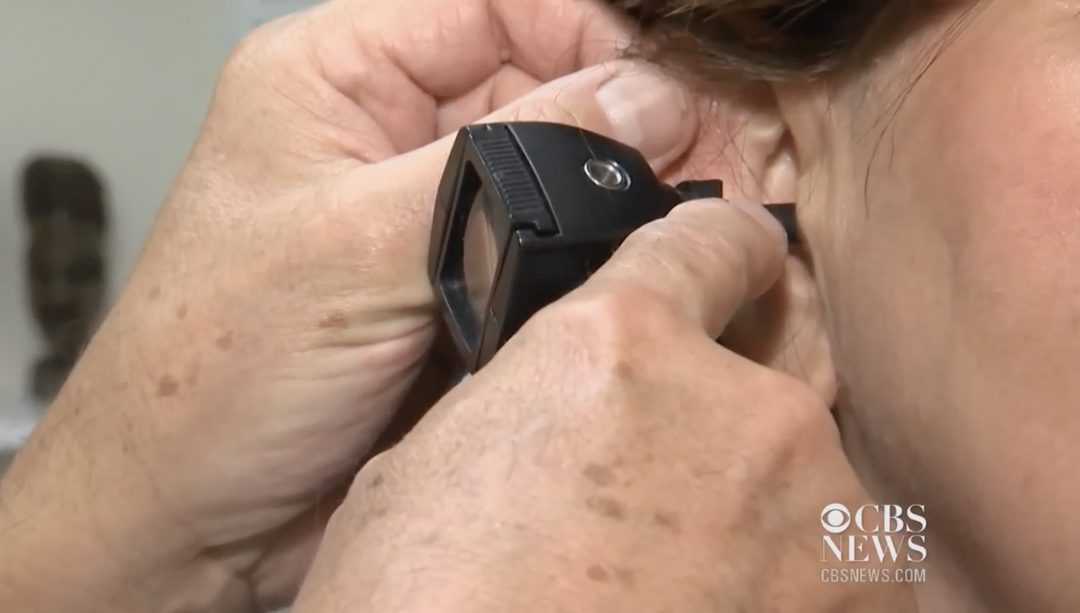
CBS News report on new tinnitus treatment guidelines
CBS News report from December 10, 2014, on new U.S. guidelines for treating tinnitus.
Sound alters brain activity during sleep in patients with tinnitus
EEG study during sleep in 10 patients with tinnitus. It measured brain electrical activity while they received their personalized sound; changes were observed mainly in sleep stages N2 and N3. Sleep Science, 2014.
FDA 510(k) clearance of the first-generation Levo System (K140845)
The original Levo System was FDA-cleared for the temporary relief of tinnitus symptoms in adults. 510(k) letter dated July 18, 2014; prescription use only. Device name in the letter: LEVO Tinnitus Masking Software Device. Holder: Otoharmonics. Class II, product code KLW, 21 CFR 874.3400.
Pilot study of personalized acoustic stimulation during sleep (2010)
Pilot study with 11 patients, stimulated every night for 6 months. It presented personalized acoustic stimulation during sleep, the basis for the later development of Levo. International Tinnitus Journal, 2010.
The Levo System at a Los Angeles medical center
CBS New York article from May 1, 2018, on the Levo System, with one patient’s account.
The Levo System Wins Top Honors at the 2017 Medical Design Excellence Awards
PORTLAND, Ore., Otoharmonics today announced that the Levo System has been awarded the top prize in the Digital Health Products and Mobile Medical Apps category of the 19th Annual Medical Design Excellence Awards competition. The 2017 winners were announced at the 2017 MDEA Ceremony on Tuesday, June 13 at the Jacob K. Javits Convention Center in New York.
Patient response to a tinnitus-matched sound during sleep
Master’s thesis (Queen Mary University of London), not peer-reviewed. It analyzed how patients respond to the personalized sound that reproduces their tinnitus and how that response changes during treatment. Author: Maryam Zuhair Aziz Waheed. MSc Neuroscience, 2025. Supervisor: Dr. Alberto Capurro; co-supervisors: Verónica Méndez and Dr. Daniel Drexler.
Impact of acoustic stimulation during sleep on sleep quality
Master’s thesis (Queen Mary University of London), not peer-reviewed. It studied how sleep quality evolved during treatment and how it related to changes in tinnitus, using data from patients of Centro Tinnitus Montevideo. Author: Thulasy Mekanathan. MSc Neuroscience and Translational Medicine, 2024. Supervisor: Dr. Alberto Capurro; co-supervisors: Dr. Daniel Drexler and Verónica Méndez.
Prognosis and variability in tinnitus treatment with acoustic stimulation during sleep
Master’s thesis (Queen Mary University of London), not peer-reviewed. It analyzed whether early variations in tinnitus intensity relate to how treatment evolves later, using data from patients of Centro Tinnitus Montevideo. Author: Purvi Rajeshkumar Patel. MSc Neuroscience and Translational Medicine, 2022. Supervisor: Dr. Alberto Capurro; co-supervisor: Dr. Daniel Drexler.
Randomized clinical trial: personalized sound therapy during sleep vs. alternatives
Randomized clinical trial with 60 participants, conducted in the United States. Researchers at the VA Portland Health Care System compared the Levo System with a tinnitus-matched sound, the Levo System with a noise chosen by the participant, and a bedside sound generator; on average, all three groups improved. Funding came from the manufacturer of the device at the time and from the U.S. Department of Veterans Affairs; study procedures and data analyses were conducted independent of company influence. American Journal of Audiology, 2017.
Impact of reduction of tinnitus intensity on patients’ quality of life (2016)
Clinical study with an earlier version of the Levo system (before Levo Gen 2): 12 patients enrolled, 11 completed, 3 months. On average, tinnitus intensity decreased by 80% and its impact on quality of life (TFI) by 77%. Drexler et al., International Journal of Audiology, 2016.
Sound alters brain activity during sleep in patients with tinnitus
EEG study during sleep in 10 patients with tinnitus. It measured brain electrical activity while they received their personalized sound; changes were observed mainly in sleep stages N2 and N3. Sleep Science, 2014.
Pilot study of personalized acoustic stimulation during sleep (2010)
Pilot study with 11 patients, stimulated every night for 6 months. It presented personalized acoustic stimulation during sleep, the basis for the later development of Levo. International Tinnitus Journal, 2010.
Randomized clinical trial: personalized sound therapy during sleep vs. alternatives
Randomized clinical trial with 60 participants, conducted in the United States. Researchers at the VA Portland Health Care System compared the Levo System with a tinnitus-matched sound, the Levo System with a noise chosen by the participant, and a bedside sound generator; on average, all three groups improved. Funding came from the manufacturer of the device at the time and from the U.S. Department of Veterans Affairs; study procedures and data analyses were conducted independent of company influence. American Journal of Audiology, 2017.
Impact of reduction of tinnitus intensity on patients’ quality of life (2016)
Clinical study with an earlier version of the Levo system (before Levo Gen 2): 12 patients enrolled, 11 completed, 3 months. On average, tinnitus intensity decreased by 80% and its impact on quality of life (TFI) by 77%. Drexler et al., International Journal of Audiology, 2016.
Sound alters brain activity during sleep in patients with tinnitus
EEG study during sleep in 10 patients with tinnitus. It measured brain electrical activity while they received their personalized sound; changes were observed mainly in sleep stages N2 and N3. Sleep Science, 2014.
Pilot study of personalized acoustic stimulation during sleep (2010)
Pilot study with 11 patients, stimulated every night for 6 months. It presented personalized acoustic stimulation during sleep, the basis for the later development of Levo. International Tinnitus Journal, 2010.
Patient response to a tinnitus-matched sound during sleep
Master’s thesis (Queen Mary University of London), not peer-reviewed. It analyzed how patients respond to the personalized sound that reproduces their tinnitus and how that response changes during treatment. Author: Maryam Zuhair Aziz Waheed. MSc Neuroscience, 2025. Supervisor: Dr. Alberto Capurro; co-supervisors: Verónica Méndez and Dr. Daniel Drexler.
Impact of acoustic stimulation during sleep on sleep quality
Master’s thesis (Queen Mary University of London), not peer-reviewed. It studied how sleep quality evolved during treatment and how it related to changes in tinnitus, using data from patients of Centro Tinnitus Montevideo. Author: Thulasy Mekanathan. MSc Neuroscience and Translational Medicine, 2024. Supervisor: Dr. Alberto Capurro; co-supervisors: Dr. Daniel Drexler and Verónica Méndez.
Prognosis and variability in tinnitus treatment with acoustic stimulation during sleep
Master’s thesis (Queen Mary University of London), not peer-reviewed. It analyzed whether early variations in tinnitus intensity relate to how treatment evolves later, using data from patients of Centro Tinnitus Montevideo. Author: Purvi Rajeshkumar Patel. MSc Neuroscience and Translational Medicine, 2022. Supervisor: Dr. Alberto Capurro; co-supervisor: Dr. Daniel Drexler.
FDA 510(k) clearance of the Levo Gen 2 Tinnitus Therapy System (K260413)
Levo Gen 2 is FDA-cleared for the temporary relief of tinnitus symptoms in adults. 510(k) letter dated August 13, 2026; prescription use only. Device name in the letter: Levo Gen 2 Tinnitus Therapy System. Holder: Levo Medical Corporation. Class II, product code KLW, 21 CFR 874.3400. The app runs on compatible iPhone and iPad devices and combines individualized sound therapy, configured by a hearing professional, with the Continuous Learning Platform (CLP).
U.S. Patent 9,301,714 B2: systems and methods for tracking and presenting tinnitus therapy data
U.S. patent issued on April 5, 2016. Title: Systems and methods for tracking and presenting tinnitus therapy data. Current assignee: Levo Medical Corporation.
U.S. Patent 9,282,917 B2: systems and methods for tinnitus therapy
U.S. patent issued on March 15, 2016. Title: Systems and methods for a tinnitus therapy. Current assignee: Levo Medical Corporation.
FDA 510(k) clearance of the first-generation Levo System (K140845)
The original Levo System was FDA-cleared for the temporary relief of tinnitus symptoms in adults. 510(k) letter dated July 18, 2014; prescription use only. Device name in the letter: LEVO Tinnitus Masking Software Device. Holder: Otoharmonics. Class II, product code KLW, 21 CFR 874.3400.
NBC Nightly News report on the Levo System
NBC Nightly News report from July 4, 2018, on the Levo System for tinnitus.
U.S. hospital applies personalized sound therapy for tinnitus treatment
CBS News report from April 27, 2018, from Los Angeles, on personalized sound therapy during sleep.
CBS News report on new tinnitus treatment guidelines
CBS News report from December 10, 2014, on new U.S. guidelines for treating tinnitus.
Contact
Briefly tell us about your case, and a member of our team will get back to you.